

I’ve been traveling the last few days, but I wanted to offer a quick reaction to some pieces of data released a couple days ago about the upcoming election. If this is your first time reading La Parte Honda, welcome! If you’d like to receive these posts directly to your inbox, you can subscribe for free below. If you find this work valuable, please feel free to share it with others. Welcome again, and thank you for reading —Javier
The interlude between the first round of February and the upcoming runoff of the Ecuadorian Presidential election has felt like a long period of stasis. Seemingly, no campaign strategy and no major political event has broken through to affect people’s vote choice. Daniel Noboa and Luisa González tied at 44% support in the first round of February 9th, and two months later their respective chances of winning the presidency are those of a coin toss.

Polls are not particularly informative at this moment. Data from Informe Confidencial earlier this week showed Noboa’s support at 45% and González’s at 42% . The pollster overshot Noboa’s advantage over González before the first round by a considerable margin (41% vs 31%, four days before the election that resulted in a tie at 44%). Noboa’s support —and chances of winning reelection through a decisive victory in the first round— was also overestimated by Comunicaliza and CEDATOS.
On the other end of the spectrum, Negocios y Estrategias was estimating an advantage for González up until pollsters could make their estimates publicly available a few days ago. The pollster underestimated Noboa’s electoral performance and overshot González’s support in the first round. Earlier this week, Trespuntozero marked González’s vote intention at 53% and Noboa’s at 47%. For every poll that shows Noboa ahead by a couple points, you can find another that shows González ahead by a similar margin.
Polling is hard —particularly in close elections and contexts of high polarization. And although polling is the best method for estimating candidate support in a race, sometimes it is necessary to resort to other kinds of data.
I am not a pollster and my perspective is usually informed by the detailed analysis of voting behavior and public opinion data. As I’ve said a few times since the first round, Noboa’s and González’s chances of winning will be largely determined by the way that voters who voted for Leonidas Iza —leftist indigenous leader and Pachakutik candidate— and Andrea González Nader —anti-correísta hardliner— break on Sunday April 13th.
Recently released data from a study by Universidad San Francisco Political Science professor Paolo Moncagatta casts some light on the way these voters might potentially break. I thought I would do a quick recap of the way I’ve been thinking about the runoff and offer a quick reaction to this new data.
***
It was always wrong to assume that Iza’s voters would support Revolución Ciudadana in the runoff because Iza is a leftist candidate. That’s not how voting behavior works: a substantial segment of Iza’s support comes from places that have supported the anti-correísta candidate decisively in the past. A more nuanced perspective required doing a deep dive into the voting behavior of Iza’s supporters in the Central Highlands (Cotopaxi, Chimborazo, Tungurahua, Bolívar and Cañar provinces, almost 45% of Iza’s vote in the first round) and Pichincha, where Quito is located (about 25% of Iza’s vote in the first round).
In summary, despite supporting an indigenous leftist leader in the first round of this election, Iza’s voters in the Central Highlands have regularly voted against the correísta candidate in previous presidential elections. Iza’s rhetoric and ability to negotiate with local leaders might have an effect on the margins, but the reasonable expectation is that Noboa is more capable of absorbing the slight majority of Iza’s votes in these five provinces. Put differently, some of Iza’s voters in this region will vote for Luisa González in the runoff, but the majority will debate between supporting Noboa or defecting to the voto nulo. It follows that every null vote, on average, hurts Noboa more than González because it represents a deficit to his count.
Pichincha (Quito) is the opposite case. Again, a detailed analysis of past election results suggests that RC might have an advantage in absorbing the votes that went to Leonidas Iza in the first round. Here, too, it follows that every null vote, on average, hurts González more than Noboa in Pichincha, because it represents a deficit to her count.
Magnitudes matter as well. About 45% of Iza’s vote is in the Central Highlands, 25% is in Pichincha, and the remaining 30% is scattered in Imbabura, Azuay, Loja and the provinces in the Amazon region. Some of these latter provinces are neither here nor there in terms of Noboa’s (or González’s) ability to absorb the votes that went to Iza in the first round —but now we’re talking about very few votes.
All in all, my baseline expectation after looking at these trends has been that Noboa might absorb the slim majority of the votes that went to Iza in the first round of February in the country as a whole. Individual data from Prof. Moncagatta from two days ago should be cause of concern for Noboa’s campaign.
According to this data, when asked about their vote choice in the runoff, respondents who said they voted for Leonidas Iza seem to be breaking 30% for Noboa, 42% González, and 28% null.
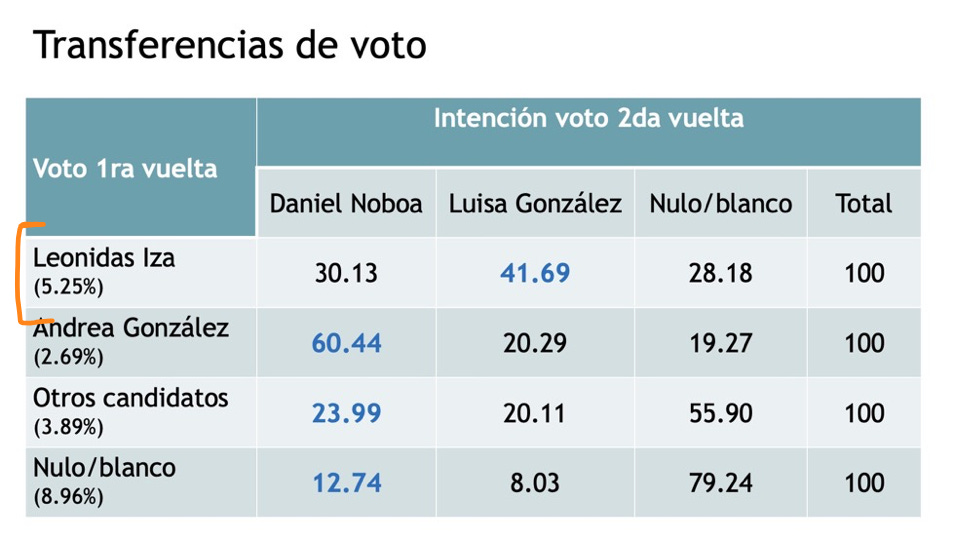
The 42% for González seems broadly in line with expectations arising from aggregate-level data and past voting behavior analysis. The 30% for Noboa seems extremely low. Both candidates seem to be losing votes to the voto nulo, but Noboa seems to be shedding more votes.
Think about it this way: if your baseline expectation is that the slim majority will break for Noboa (call it 51/49, the slimmest majority), any deviation from it should be interpreted as a sign of either overperformance or a candidate falling short of the expected support. With González at 42% in the table, the RC candidate appears to be getting about the level of support that she’s supposed to get, perhaps losing a few votes to the null. Noboa, on the other hand, appears to be getting considerably less than otherwise would be expected.
I have not spoken to Dr. Moncagatta about the geographic breakdown of the null votes in that cell in the first row. But I would not be surprised if the vast majority of those are coming from the Central Highlands. If that’s indeed the case, it would be supporting evidence in favor of the model that I’m using to think about the runoff: Iza’s supporters in the Central Highlands that are defecting to the voto nulo are hurting Noboa.
The second row in the table should be taken as an even more worrying sign for Noboa. The vote of Andrea González Nader, an anti-correísta hardliner, cannot be described as anything other than an anti-correísta vote. The key is that, as I’ve argued in the past, her voters seem to be anti-correístas as well as anti-Noboa. Still, the general expectation is that negative partisanship should prevail, and the majority of those votes should go to Noboa in the runoff. Those who defect to the null hurt Noboa because they represent a deficit to his vote count.
Moncagatta’s data is currently showing a very small margin in the way Andrea González voters might break.
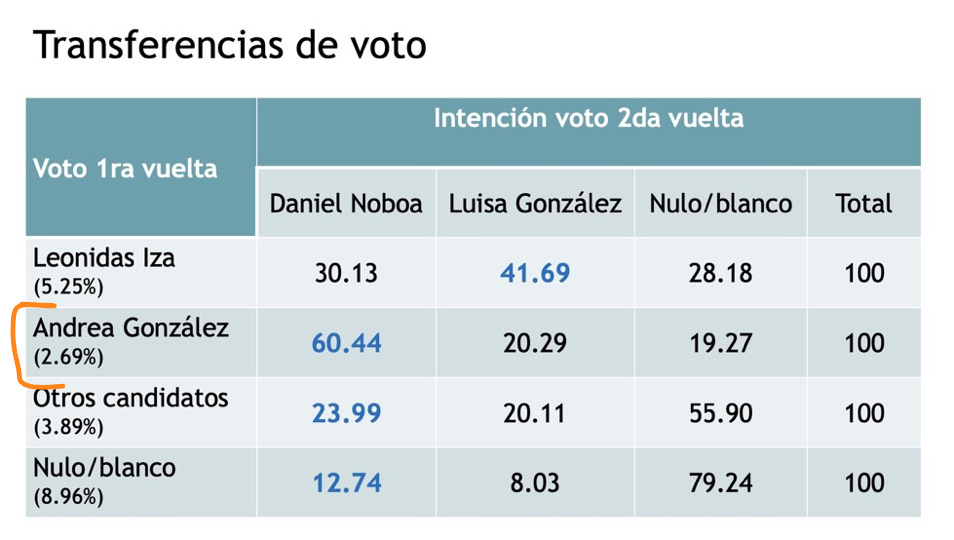
At 60% for Noboa and 20% González, Noboa’s margin with Andrea González supporters is only +40. This is much lower than I expected, and should be a cause of concern for Noboa’s campaign.
Null votes in Ecuador do not count toward the computation of the official result. For example, out of 100 votes, if candidate A gets 40 votes, candidate B gets 50 votes, and 10 voters cast a null ballot, then candidate B is the winner with 55.6% —that’s 50 divided by 90, not 100. The null votes don’t count toward the computation.
At a margin of +40, Noboa would be getting only 4 effective votes that count toward the result, out of every 10 voters that voted for Andrea González in the first round.
The individual data that I’ve reviewed in this post was collected by Comunicaliza, the pollster that the USFQ team hired for this research project, as stated by Dr. Moncagatta. This means that any bias and house effect that Comunicaliza might have introduced in any of their measures of the horse race might potentially be present here as well.
To end with a word of caution, I will be the first one to say that vote recall data is problematic for many reasons —people do not recall who they voted for, or lie when responding to a poll because of different reasons that have been well-documented in social science. I will also acknowledge that this is only one study and that I might be reading too much into it.
But Ecuador, unlike the US, or even other countries in the region, is a place where polling and public opinion data is scarce, and one has to do with what’s available. More importantly, I’m trying to be as explicit as possible with the assumptions behind the model that I’m using to make sense of this election. At the time of this writing, betting markets are giving Luisa González an above 60% chance of victory in tomorrow’s runoff. I’m not in the business of making electoral predictions, but I will say that while my baseline expectation has been that Noboa might win the presidency by a slim margin, now I can see the case for an advantage of Luisa González.