

A very unusual election
The results of the first round of the presidential election in Ecuador were extremely unusual: two candidates —out of sixteen— got nearly 90% of the vote.
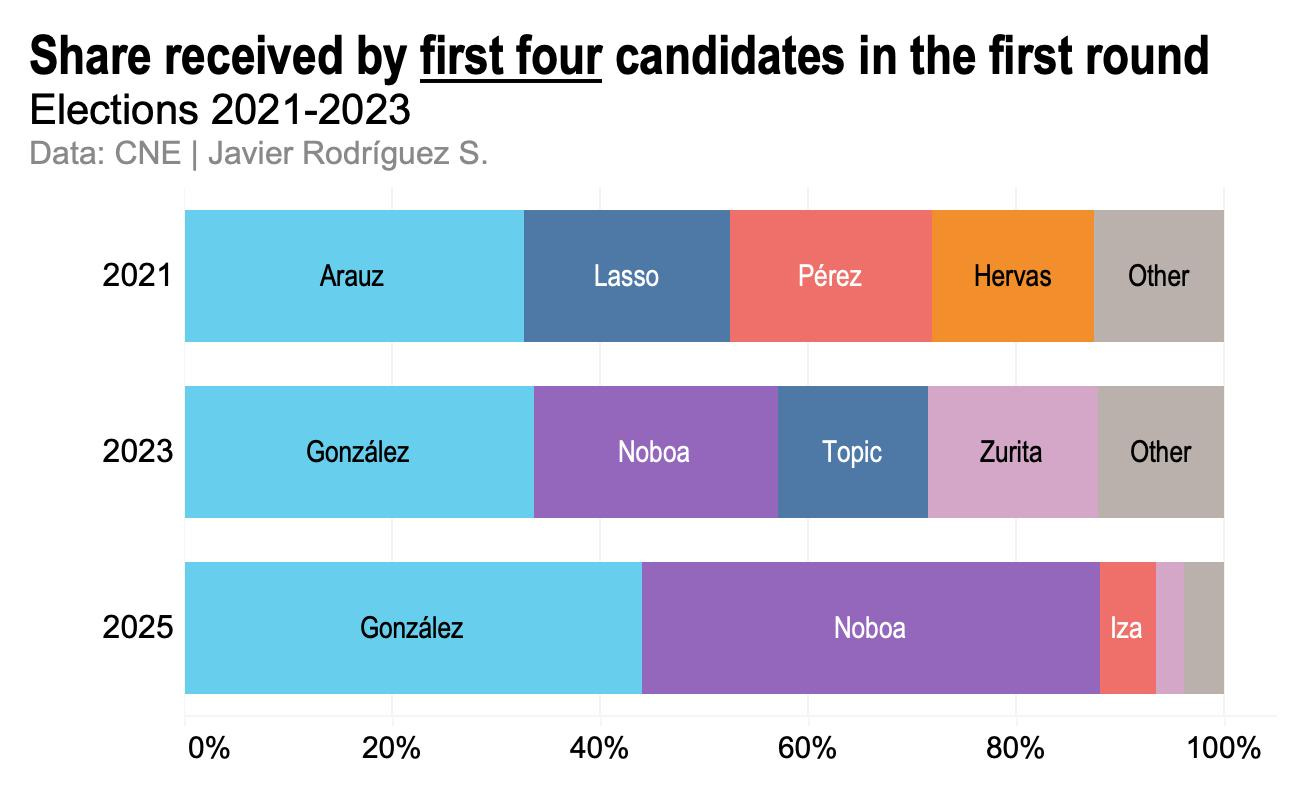
Luisa González and Daniel Noboa tied at 44% and will face off again in the runoff election in April. Indigenous leader Leonidas Iza, the Pachakutik candidate, took third place with 5%. Andrea González, representing Partido Sociedad Patriótica, founded by former President Lucio Gutiérrez, took fourth place with less than 3%. The remaining twelve candidates each got less than one percent of the vote.
The first round of 2025 appears to have been a reprise of the 2023 runoff, when Daniel Noboa was elected president. I believe this claim makes sense for various reasons. The 2023 runoff took place only fifteen months ago and the same two candidates were on the ballot —González, handpicked by former President Rafael Correa to represent his movement, Revolución Ciudadana, was the candidate in 2023, too. The other parties did not decide on their nominees until only a few months ago, leaving very little time for the public to get to know them or consider them as viable options. Qualitative data from focus groups suggested that voters were “tired” of having to go to the polls so frequently and perhaps did not have the bandwidth or the interest to learn about new candidates. The two leading candidates, Noboa and Gonzalez, were, after all, known quantities.
If the results of the first round from Sunday February 9th must be read through the lens of the comparison with the runoff from 2023, then some of the assumptions about voting behavior on the part of voters should be made explicit.
It seems like the same views, preferences, and attitudes that went into the black box that informed voters’ choices back in 2023 were at play in the first round of 2025 as well. Voters cast their votes in this first round as if they were voting in a runoff —two candidates got nearly 90% of the vote. That means, importantly, that the two frontrunners already absorbed nearly all of the other votes that normally go to the other candidates in the first round, and there’s very little room for maneuver between now and the runoff in April.
Typically, a few candidates receive a substantial share of the vote in the first round. Then, voters must decide which of the two frontrunners to vote for in the runoff, and some voters cast a “null” vote —spoiling the ballot as a signal of lack of support for either of the two finalists. Imagine a world where, similarly, Noboa and González tied in the first round, but their tie was at 30%. If both candidates, combined, had gotten 60% of the vote and the remaining 40% had spread out among the rest of the candidates, then we would say that 40% of the vote is up for grabs.
That’s not the case this year. The two leading candidates got 90%, and the fact that only 10% is there for the taking means that any campaign strategy leading to the runoff will be more limited, if only because of this structural constraint.
Noboa’s path to victory seems to narrow
The results of the first round also suggest that the path to victory for President Daniel Noboa, who’s seeking reelection, seems to have narrowed considerably.

Noboa won in 2023 thanks to a broad and diverse coalition that voted against the return of correísmo to power. Think of it the way that you would understand populist, leftist leader Pedro Castillo being elected President in 2021 in Peru with the support of a heterogeneous coalition of antifujimoristas who coalesced behind the candidate in order to prevent Keiko Fujimori from winning the presidency. In Ecuador, in 2023, Noboa won the presidency, but for many voters it didn’t matter who the candidate was, as long as it wasn’t a Correa loyalist. If the alternative had been different, the same coalition would’ve supported that other candidate in order to prevent the return of correísmo.
In the first round of 2023, Luisa González and Daniel Noboa got 34% and 24% of the vote, respectively. The day after that first round, when speculating about what would happen with the votes that went to the other candidates, it was reasonable to expect that Noboa would win with a fair margin in the runoff. Ultimately, that’s what happened.
I believe things are much different now after seeing the results of the 2025 first round.
If Noboa already absorbed all the vote that he would’ve gotten in the runoff, then the most appropriate comparison is between his performance in the first round of 2025 and that of the 2023 runoff. And that’s where Noboa seems to fall short: he didn’t hit the mark that allowed him to win last time.
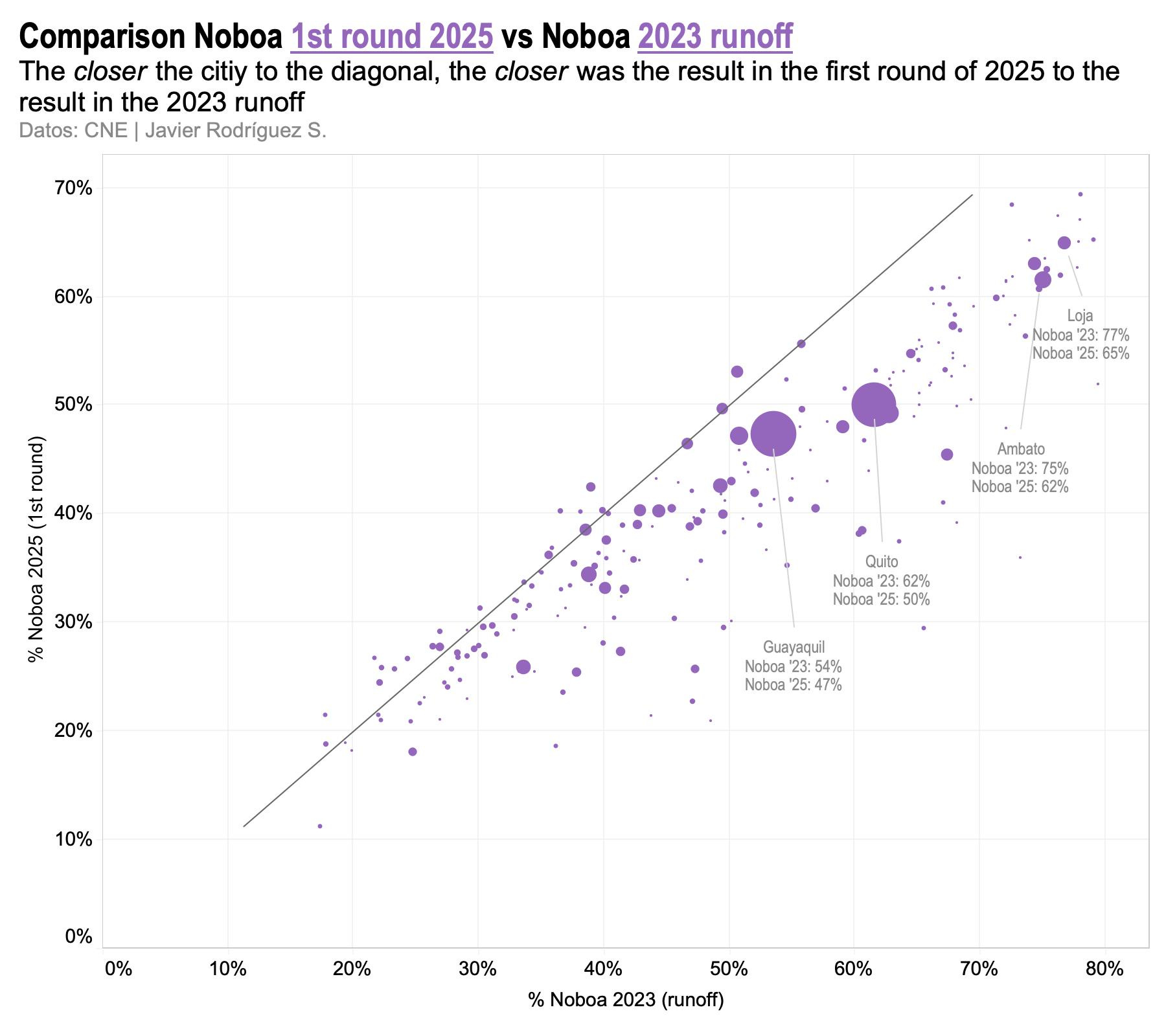
Looking at different cities, there are large gaps between what Noboa got in 2023 and what he got in 2025. Tellingly, those gaps are particularly large in places where he got his highest support. In Ambato, a city in the central highlands and one of the largest strongholds of Noboa in the last two elections, the President got 75% of the vote in 2023 and 61% in 2025. In Loja, one of the largest cities in southern Ecuador and one of the places where Noboa has gotten consistently high support, he got 77% in 2023 and 65% in 2025.
Quito and Guayaquil are the two largest cities in the country. Combined, they account for over 30% of the vote in Ecuador. In Quito, Noboa got 62% in the 2023 runoff and 50% in the first round of 2025. In Guayaquil, he got 54% in 2023 and 47% in 2025. These differences in percentage points are not an artifact of changing the denominator, i.e., the total number of votes cast. Ecuador has compulsory voting and the total number of votes cast in the 2025 election is nearly the same as in 2023. Broadly speaking, in the first round of 2025 Noboa got half a million votes less than in the 2023 runoff.
How can Noboa make up for those gaps and reach the level that allowed him to win in 2023? More specifically, how is he going to make up for those greater-than-10-point gaps where, in many places, there’s only 10% of the vote up for grabs? It sure seems difficult.
When comparing the votes received by Luisa González in 2025 to her performance in the 2023 runoff, things look very different. It seems like González was able to hold onto the votes that she got in the second round of 2023, when she lost to Noboa.
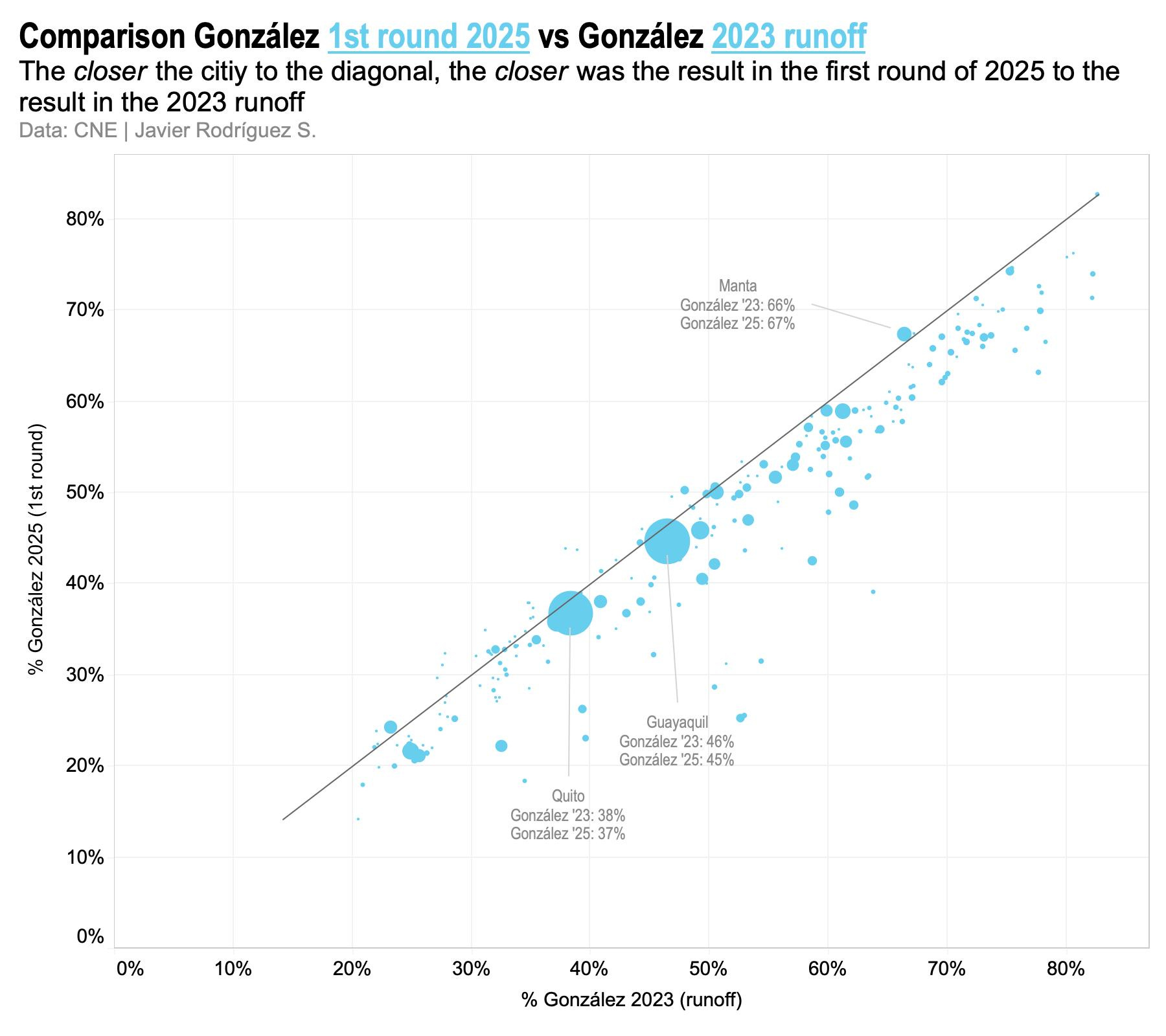
Again, this is not an artifact of changing the denominator, i.e., the total number of votes cast. In the first round of 2025, González got practically the same number of votes as in the runoff election of 2023.
How can Noboa and González grow their support in the 2025 runoff?
At this point, it seems like one of the deciding factors will be the votes that indigenous leader Leonidas Iza obtained in the first round.
The third place in the first round of 2025 with a little more than 5% of the vote was Pachakutik candidate Leonidas Iza. While his strongest support was certainly seen in rural, heavily indigenous precincts, the vast majority of his votes come from large cities —presumably from progressive, environmentally-minded voters from urban areas. More than 50% of Iza’s votes came from only nine cities. Quito alone accounts for nearly a fifth.
It is too early to tell how Iza supporters will vote in the runoff in April. On the one hand, in his rhetoric, Iza opposes Noboa’s approach to government austerity and natural resource exploitation, but on the other hand, the indigenous movement has had a contentious relationship with correísmo, as many indigenous leaders protested Correa’s authoritarian abuses while in office.
Separately, Iza’s supporters are not a monolith. In previous elections we’ve seen that supporters of an indigenous candidate from the central highlands are more likely to support the anticorreísta alternative in the runoff, while supporters from Quito are more likely to either support the correísta candidate or spoil their ballot.
Just to provide a sense of magnitude and to put things in perspective, consider the nine cities where 50% of Iza’s votes came from. In Quito, which accounts for nearly a fifth of Iza’s votes, Luisa González obtained nearly the same result in 2025 and 2023: 34% vs 35% of the vote. Noboa’s support dropped from 57% to 47%. Iza got 6% in February of 2025.
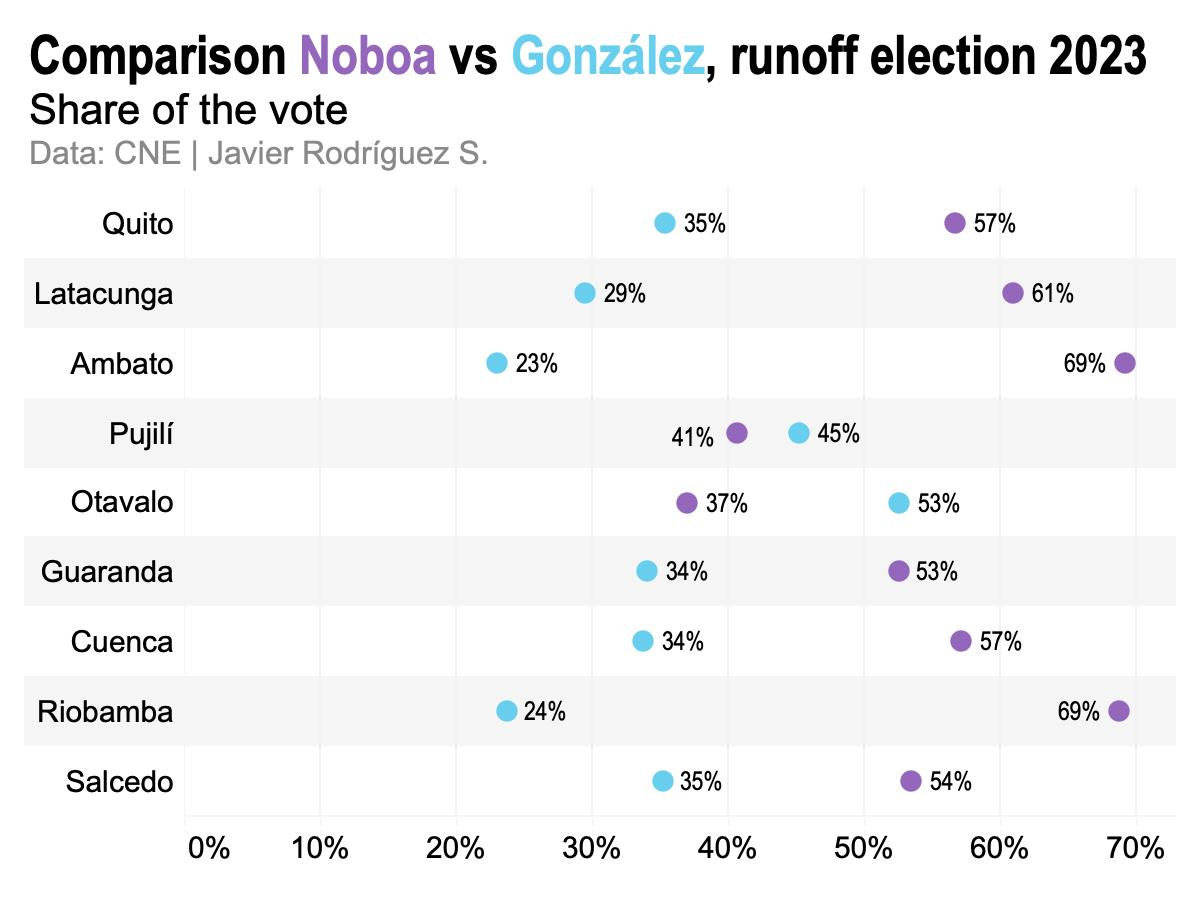
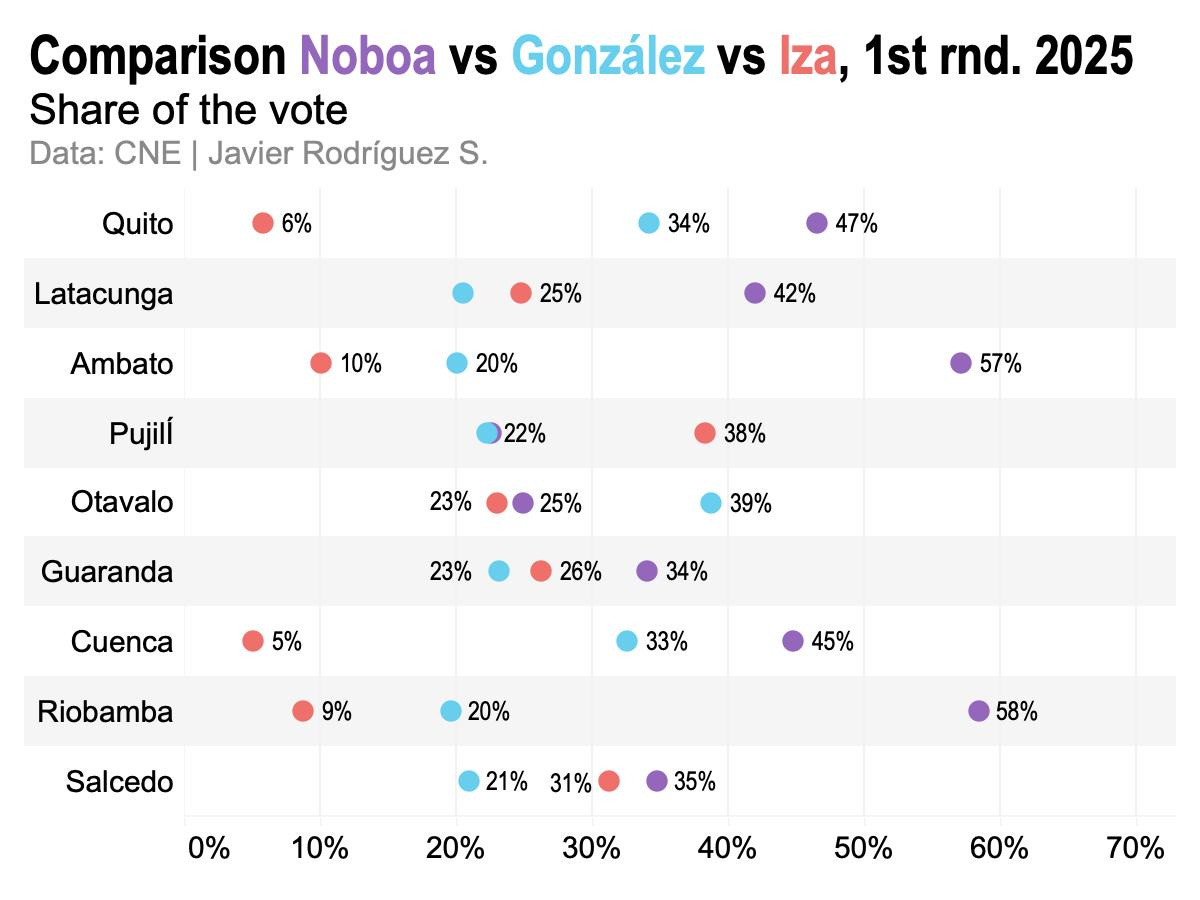
In the second largest city of that list, Cuenca, González maintained the level of support (34% vs 33%), Noboa dropped 12 points (57% vs 45%), and Iza got 5%. In Ambato, González maintained her support at 20-23%, Noboa dropped 12 points, from 69% to 57%, and Iza got 10%.
Noboa’s drop in support is explained, in part, by Iza’s support, but also, in part, by the share of the vote obtained by Andrea González Nader, the anticorreísta candidate who took fourth place with less than 3% overall. It is reasonable to expect that most of the votes that went to Andrea González in the first round will go to Noboa in the runoff, but again, it’s less than 3% of the vote. Iza’s votes are more consequential.
Noboa’s path to victory
In light of the circumstances, in order to win, Noboa must maintain the support he achieved in the first round, and in addition, he must add practically all the votes that went to Andrea González, plus nearly all of the votes that went to the other right-leaning candidates, plus a non-trivial share of the vote that went to Leonidas Iza —in the order of 30-40%, other things equal.
A second path to victory would require that a substantial share of the vote that went to Iza in the first round in provinces like Pichincha, Azuay, and the coastal areas, fails to go to Luisa González and, instead, becomes part of the null vote in the runoff. Such scenario was seen before in 2021, when a substantial share of the vote for indigenous leader Yaku Pérez failed to translate to support for correísta candidate Andrés Arauz in the runoff. The null votes reached a record-breaking 16% in 2021, but it’s because those votes came systematically from correísmo strongholds that Arauz felt short and Guillermo Lasso won the presidency. I published some pieces back in 2021 on how that might happen before the 2021 runoff, and explaining what ended up happening and how Lasso won.
A third path is counterintuitive: Noboa could get some Luisa González voters to break for him in the runoff. Many of González supporters are, in fact, “fragile” supporters. In the first round of 2025, correísmo achieved a level of support that was well above the normal level of support observed in previous elections. This means, some voters voted for correísmo this time, but they had not done so in the past. It’s impossible to read into the black box that informs voters’ choices and it is hard to say how many of these new, fragile voters will stick with González in the runoff. Noboa’s campaign strategy, although limited, could potentially persuade some of those voters. Keep in mind, however, that the same applies the other way around. Noboa also achieved a level of support that was unseen before, and that inevitably includes some fragile supporters.
Ultimately, the outcome of the runoff will be the result of the various dynamics described above. Elections in Ecuador, as elsewhere, are decided on the margins.